
Moravia: Where EcoManka’s Method Met the Real World
Our first funded pilot in Medellín brought together gardening, emotional learning, storytelling and entrepreneurship, and taught us what a scalable youth eco-leadership programme actually needs.
A neighbourhood that made the idea real
Moravia is difficult to explain in one sentence. It is a neighbourhood in Medellín shaped by displacement, migration and the legacy of the city’s former landfill, but also by years of community organising, urban gardening, cultural work and environmental recovery. What makes Moravia compelling is precisely that tension: a place marked by environmental damage that has also become a story of reinvention.
That made it a natural place for EcoManka’s first funded pilot.
In 2025, together with Corporación JARUM, a local technical and environmental organisation rooted in Moravia, and with support from Fundación Ancla / Ankarstiftelsen, we launched Verde Esperanza. The project received US$15,000 to test an educational model that combined urban gardening, socio-emotional learning, youth leadership, storytelling, ecotourism, marketing and entrepreneurship.
The question behind the programme was simple: what happens when environmental education is a journey that begins with the young person, and ends with something changing in the community?
Building with JARUM
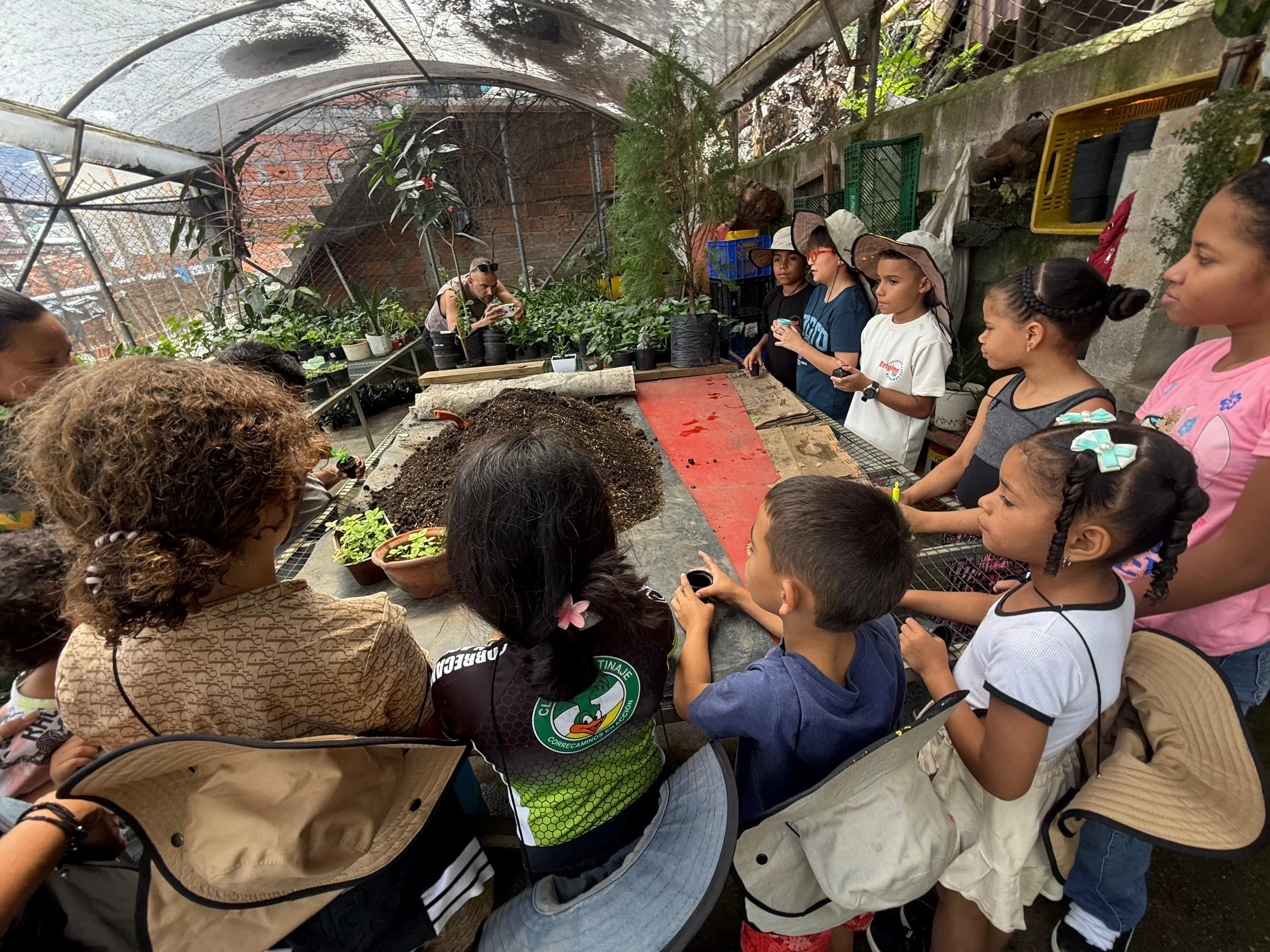
Our local partner, Corporación JARUM, was central to the project. The programme was built through a process of pedagogical co-creation. JARUM brought its own experience in socio-environmental education, community co-creation, environmental management and relationships with local organisations, collectives and institutions in Moravia. EcoManka contributed its emerging learning journey, socio-emotional learning, facilitator development, storytelling, entrepreneurship and youth eco-leadership approach. Together, the two teams adapted the programme to the realities of Moravia.
That partnership mattered because EcoManka was never meant to arrive with a ready-made curriculum and simply “deliver” it. The programme had to make sense in Moravia.
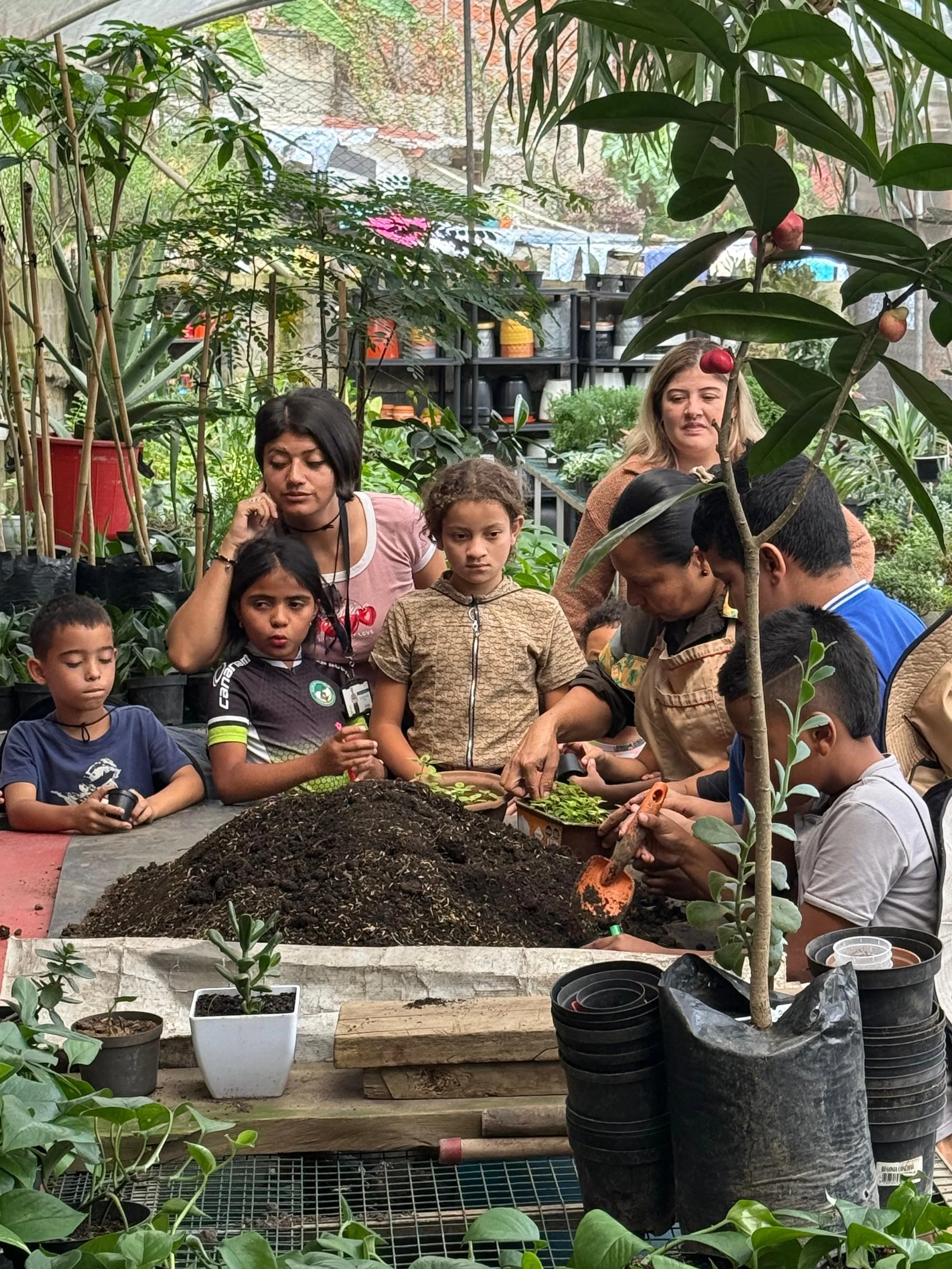
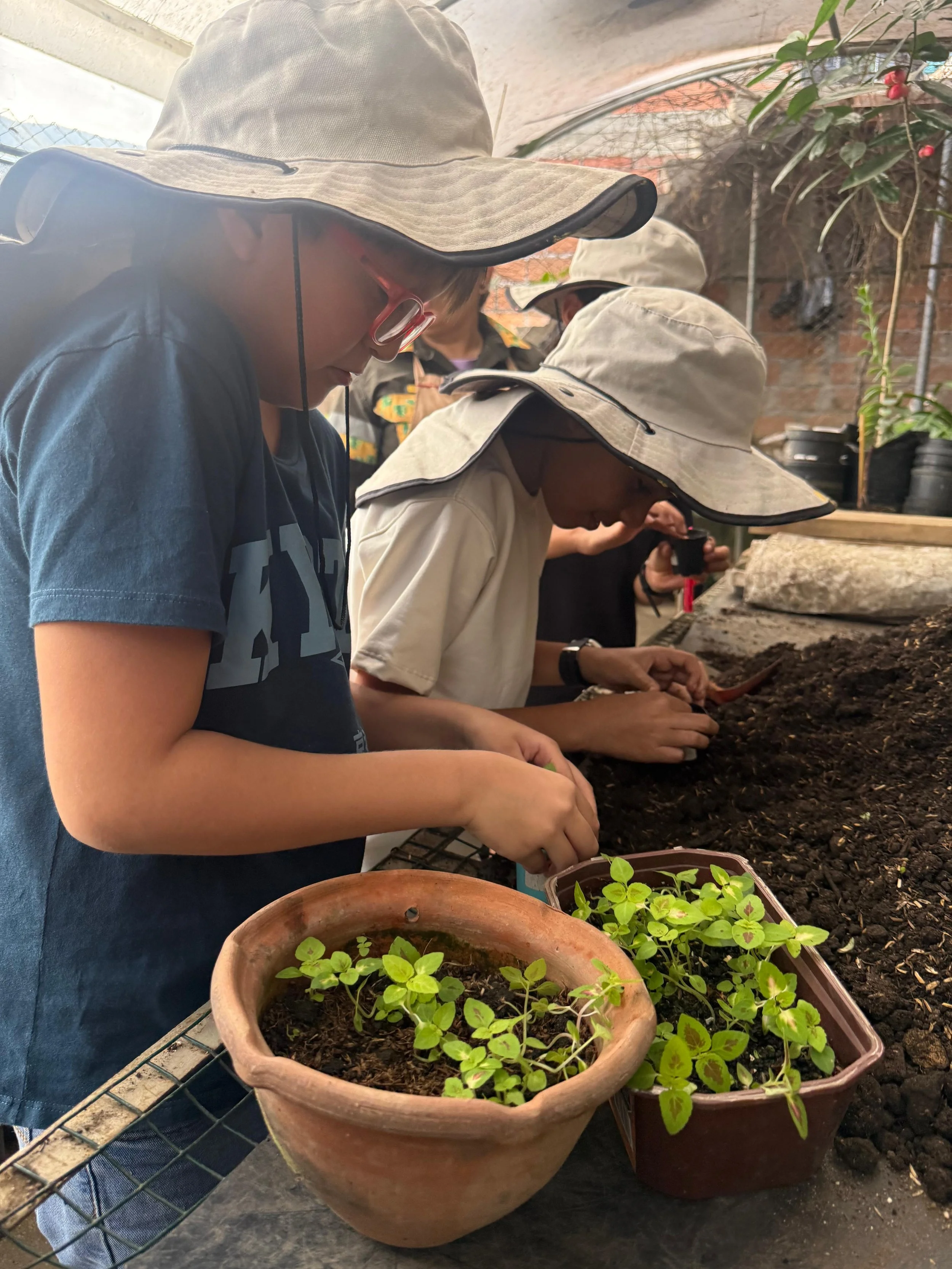
Young people walked the neighbourhood, mapped places that mattered to them, looked at neglected public spaces and discussed what could realistically be transformed. The gardens grew out of that process. Participants helped identify sites affected by waste or neglect, then worked with local practitioners, neighbours and environmental groups to clean, design, plant and care for them.
By the end of the first semester, two community gardens had been created and 75 new plants introduced. The number of recorded plant species at the sites increased from four to eleven. The planting strategy also had an ecological purpose: native species and plants attractive to pollinators were intentionally incorporated, connecting the gardens with broader efforts toward biodiversity and ecological recovery in the neighbourhood. Later, the project expanded to other spaces in the neighbourhood with the support of local organisations and residents.
The gardens were visible. The learning behind them was less obvious, but perhaps more important.
More than environmental education
One of the ideas EcoManka wanted to test was that young people do not become environmental leaders simply by learning more facts about the environment.
They also need confidence, emotional awareness, communication skills, resilience and a sense that their ideas matter.
So Verde Esperanza combined gardening and ecology with mindfulness, movement, socio-emotional learning and leadership. Participants described some of those sessions as liberating, fun, intense and revealing. The programme began to show us that environmental action and inner development are not separate tracks: they reinforce each other.
The same was true of storytelling. Moravia has often been defined from outside by narratives of waste, poverty or vulnerability. We wanted young people to explore what happened when they became the ones telling the story of their neighbourhood.
Through ecotourism and storytelling sessions, participants created maps, identified cultural and environmental landmarks and experimented with guiding one another through the territory. Later, they used augmented reality to build a prototype route called Urban Tour EcoManka JARUM.
The augmented-reality layer also became a way of reclaiming territorial memory and making local narratives visible. Through the prototype, young people could connect places in Moravia with stories of environmental transformation and community history. At the same time, the feedback showed that people valued the human encounters, local stories and neighbourhood itself even more than the digital layer. That distinction has stayed with us: technology can help preserve and amplify local narratives, but it should support human connection rather than replace it.
When ideas became real
As the programme developed, entrepreneurship became increasingly important.
Young participants began turning observations from the neighbourhood into ideas for products, services and experiences. They worked on simple business models, marketing and presentations, eventually developing newly locally created concepts such as Dulce con Encanto (Magic Sweetness), Fruta Seca (Dry Fruit), and Peinados Mágicos (Magical Brushing).
Some of those ideas moved beyond the classroom. At the local neighbourhood CORSERBA fair, young participants presented their projects to real visitors and made their first sales.These ventures also connected the programme with Moravia’s local circular economy and community commercial networks, showing that environmental and entrepreneurial learning could connect directly with real livelihoods and neighbourhood economies.
That moment captured something important for us: the difference between learning about entrepreneurship and actually trying something in the world.
It is one thing to ask a teenager to design a hypothetical project. It is another to stand behind a table, explain your idea to a stranger and realise that somebody is willing to pay for what you created.
The pilot changed the method
The most useful part of Moravia was that the programme did not unfold exactly as planned.
Participation fluctuated. School schedules and ICFES preparation competed with the sessions. Some workshops connected strongly; others did not. The team changed the timetable, adjusted the number of modules, added more entrepreneurship and experimented with different facilitation styles.
The young people also told us something important. Practical activities via walking, gardening, mapping, building and experimenting worked better than abstract ones. In one evaluation, 75% of respondents said they were regularly applying what they had learned, while hands-on activities in the territory were among the most valued.
At the same time, 62.5% felt they had not had enough opportunities to express their own ideas during some sessions. Rather than treating that simply as a weakness in facilitation, it became an important push toward greater youth governance within the programme.
The same happened with practical constraints. School schedules and ICFES preparation meant that the original timetable did not always work, so the team and participants adjusted the rhythm of the programme together. Facilitation became increasingly horizontal, with young people taking a stronger role in social mapping, territorial walks, creative expression and shared decisions about the activities.
That strengthened a principle that now sits at the heart of EcoManka: youth leadership cannot simply be declared by adults. Young people become protagonists when they have genuine influence over the process, the learning and the actions that emerge from it.
What we carried forward
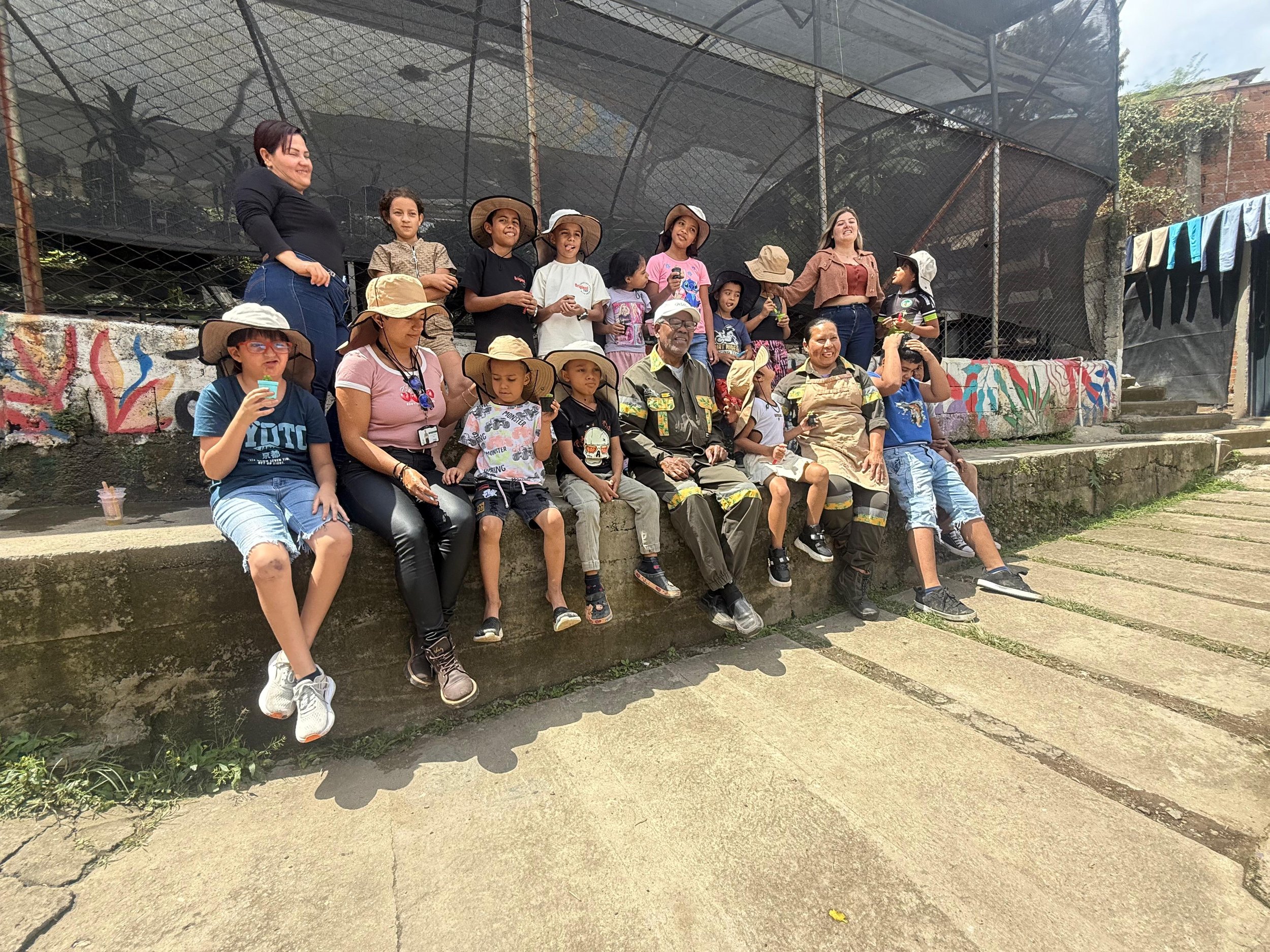
By the end of the year, Verde Esperanza had grown into a small ecosystem involving young people, schools, local environmental groups, cultural organisations, neighbours and community leaders. Around 200 people took part across two larger community events in the second half of 2025, while gardens, youth ventures and local partnerships made the work visible beyond the original group.
For EcoManka, though, the biggest result was not any single garden, workshop or business idea. It was clarity.
Moravia showed us that the strongest environmental learning happens when several things connect: the inner world of the young person, relationships with others, connection with nature, understanding of the territory and finally the confidence to act.
It also showed us what needed improving: a clearer learning journey, stronger facilitator preparation, more meaningful youth participation, better evaluation from the beginning and a sharper distinction between what should remain core to EcoManka and what should be co-designed and adapted with local partners and communities
One participant, Jerónimo, had joined partly because he wanted to leave the house and meet people after several years of virtual schooling. Looking back, he said that even something as simple as going out and planting had turned into learning “many more things.” Another participant spoke about learning not only about nature, but about how to understand his own body and express himself differently in relation to it.
That is probably the best summary of what Moravia became for us.
It started as a funded pilot in environmental education.
It became the place where EcoManka began to understand what its method could really be.
